

By Sherry MacLeod
Managing Broker, Cape Breton Realty
Each Friday afternoon we do a Facebook live from our office. Recently we talked about something many people are thinking about but not always planning clearly enough — retirement.
I had recently watched and shared a video featuring Warren Buffett, who was discussing long-term investing and financial security. One point he made stood out: income-producing real estate can be a powerful tool for retirement planning.
That idea isn’t new, but it remains remarkably practical.
Unlike many investments that fluctuate dramatically, real estate has two characteristics that make it attractive over the long term. First, it tends to hold its value over time. Second, it can produce steady monthly income.
For many people approaching retirement, those two factors matter more than anything else.
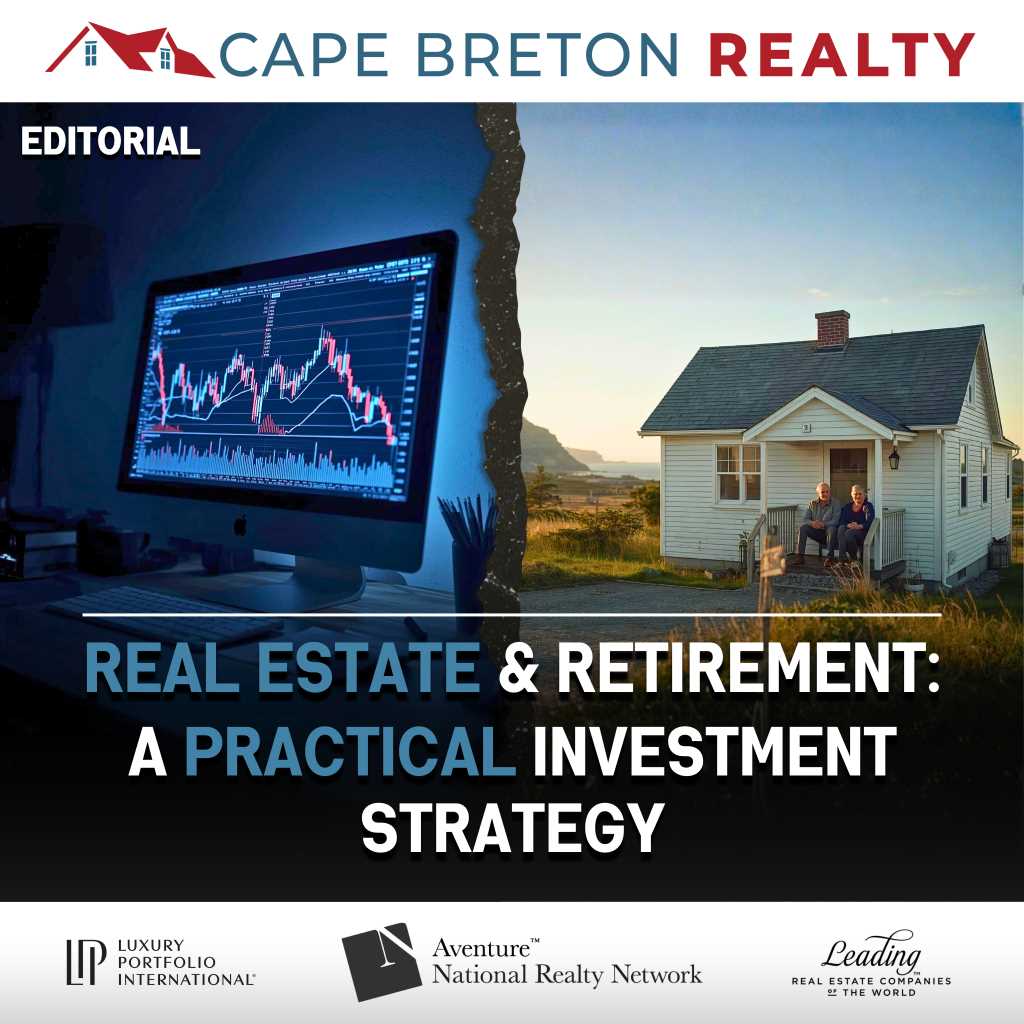
Stocks and financial markets can generate strong returns, but they can also be unpredictable. A portfolio that looks strong one year can drop sharply the next. For someone relying on those investments to fund retirement, that volatility can be stressful.
Income-producing real estate works differently.
If you own a rental property that is properly maintained and located in a stable market, the monthly rent can provide a reliable stream of income. That income may help cover living expenses, supplement pensions, or provide a financial cushion during retirement years.
Here in Cape Breton and Northeast Nova Scotia, this strategy is particularly interesting because our property prices remain relatively affordable compared to larger urban markets.
In places large centers, buying an investment property often requires enormous capital. Prices are so high that it can be difficult for rental income to cover costs. In smaller communities, the equation can look very different.
A modest rental property may be purchased at a price where rental income still makes sense. Over time, that property may appreciate while also producing monthly income.
That combination — long-term value plus ongoing income — is exactly why many investors have historically viewed real estate as a cornerstone of retirement planning.
Of course, real estate is not a completely passive investment. Properties require maintenance, tenants must be managed, and markets can shift. But compared with many financial investments, real estate offers something tangible.
You can see it.
You can improve it.
And you can control it in ways that are often impossible with other types of investments.
Another advantage is that real estate can act as a hedge against inflation. As the cost of living rises, rents typically rise as well. That means the income from a property may adjust over time in a way that helps maintain purchasing power.
For retirees living on fixed incomes, that can be extremely valuable.
Real estate also allows for flexibility. Some people choose to live in part of their property while renting another portion. Others invest in small multi-unit buildings, cottages, or seasonal rentals. In many cases, the property itself becomes both an asset and part of a lifestyle.
But perhaps the biggest lesson is this: planning matters. Imagine buying a property for a rental at 40 as it’s likely paid for by the time you retire
Retirement strategies rarely work if they begin only a few years before someone stops working. Building a reliable income stream often requires thinking decades ahead.
Purchasing a rental property earlier in life, paying down the mortgage over time, and entering retirement with a property that generates income can create financial stability that many retirees find reassuring.
Real estate is likely not the only retirement strategy, but it remains one of the most understandable and practical ones available.
And sometimes, the simplest ideas — owning something of lasting value that produces steady income — turn out to be the most reliable investments of all.
