
By Sherry Macleod
Managing Broker Cape Breton Realty
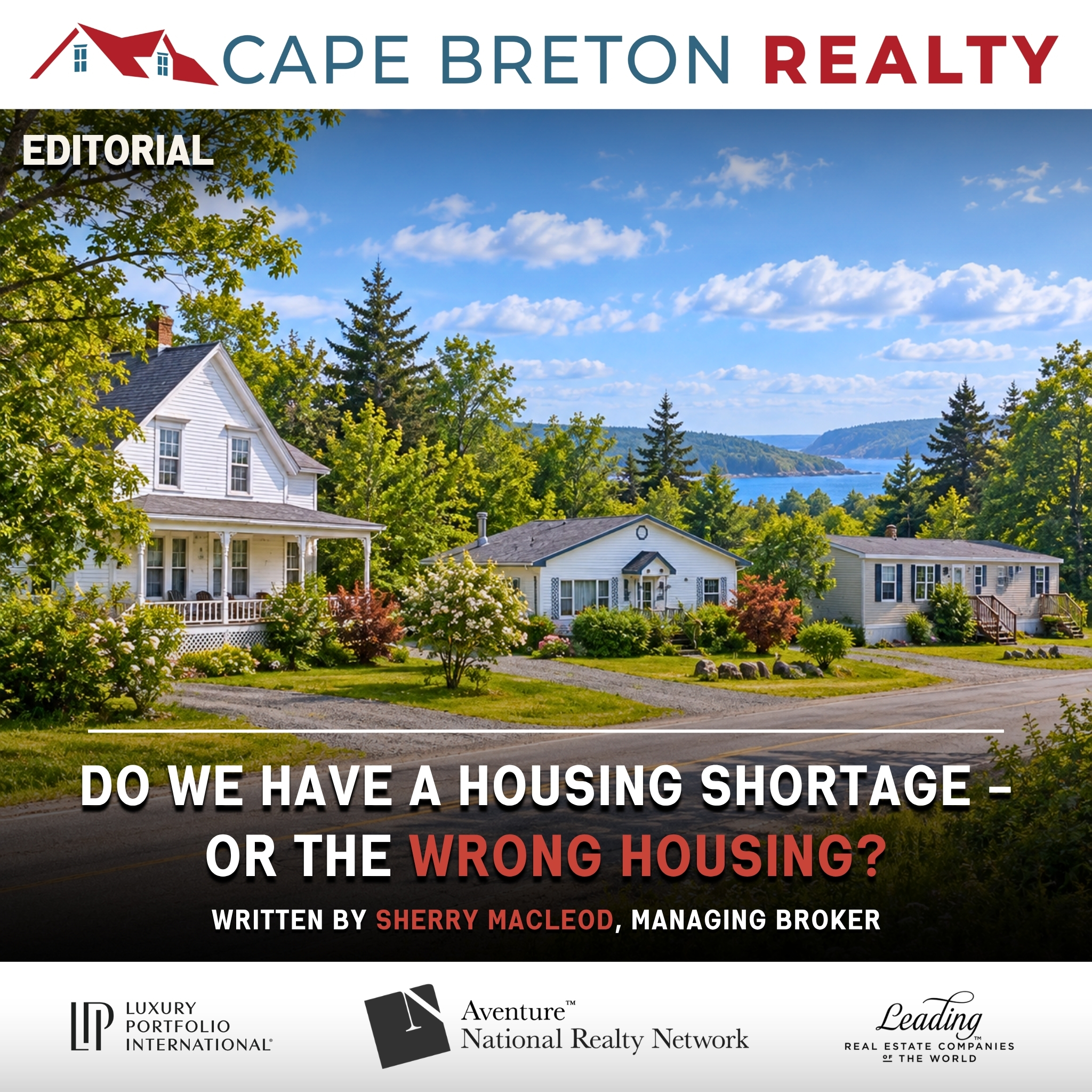
Canada is in a housing crisis. At least, that is what we continue to hear.
CMHC’s latest report says Canada needs between 417,000 and 469,000 new homes every year to restore housing affordability to pre-pandemic levels by 2036. It also acknowledges something important: population growth is slowing, rental markets are becoming more balanced and conditions vary considerably from one market to another. (Canada Mortgage and Housing Corporation)
That raises a question worth asking: What does the housing crisis actually look like here in Cape Breton and Rural Nova Scotia?
In Cape Breton and rural Northeastern Nova Scotia, properties are staying on the market longer. Multiple offers are far less common than they were during the pandemic years. Buyers have more choice and more time to make decisions.
Yet people still struggle to find housing.
Those two things can be true at the same time.
Perhaps our problem isn’t simply that we don’t have enough housing. Perhaps we don’t always have the right housing, at the right price, for the people who need it.
Young Nova Scotians still want to own homes. They shouldn’t have to assume home ownership is something that must wait until they are 40. In many rural communities, we still have homes at prices that can make ownership attainable.
At the same time, many newcomers and temporary foreign workers begin their lives here in lower-paying jobs. Home ownership may be years away. They need safe, decent rentals at prices their incomes can support.
Those are two very different housing needs, and building more units alone doesn’t necessarily solve both.
It also illustrates why housing policy needs a much stronger local lens.
Vancouver Island and Cape Breton Island may both be beautiful places surrounded by water, but their real estate markets bear little resemblance to one another. Even Halifax and rural Cape Breton face very different circumstances.
Consider Nova Scotia’s Non-Resident Deed Transfer Tax. The Province introduced it at 5% in 2022 and increased it to 10% in 2025. (Government of Nova Scotia)
For decades, rural Nova Scotia worked hard to develop a market among buyers from Europe, the United States and other parts of Canada. They bought cottages, waterfront homes and rural properties that did not always have a local buyer waiting.
Their economic contribution didn’t stop with the purchase.
They renovated houses, hired contractors, bought furniture, vehicles, boats and ATVs, paid property taxes, ate in our restaurants and shopped in our stores.
We spent years building that market.
It doesn’t take nearly as long to lose it.
A 10% provincial tax means an additional $40,000 on a $400,000 property for a buyer to whom the tax applies. Buyers have choices. When the additional cost becomes too great — or they simply feel their investment isn’t particularly welcome — they can look elsewhere.
That matters differently in a rural community than it might in a market where dozens of buyers are competing for every property.
This is why we need to be careful about painting every housing market with the same brush.
Yes, Canada needs housing. CMHC’s numbers make a compelling case that we need considerably more construction over the next decade. (Canada Mortgage and Housing Corporation)
But what we build, where we build it and who needs it matter just as much as how many units we build.
Housing problems are local. Our solutions need to recognize that.
Before spending billions solving Canada’s housing crisis, perhaps we should first make certain we understand the housing problem in each community.
Because the solution Cape Breton needs may be very different from the one Halifax or Vancouver needs.