

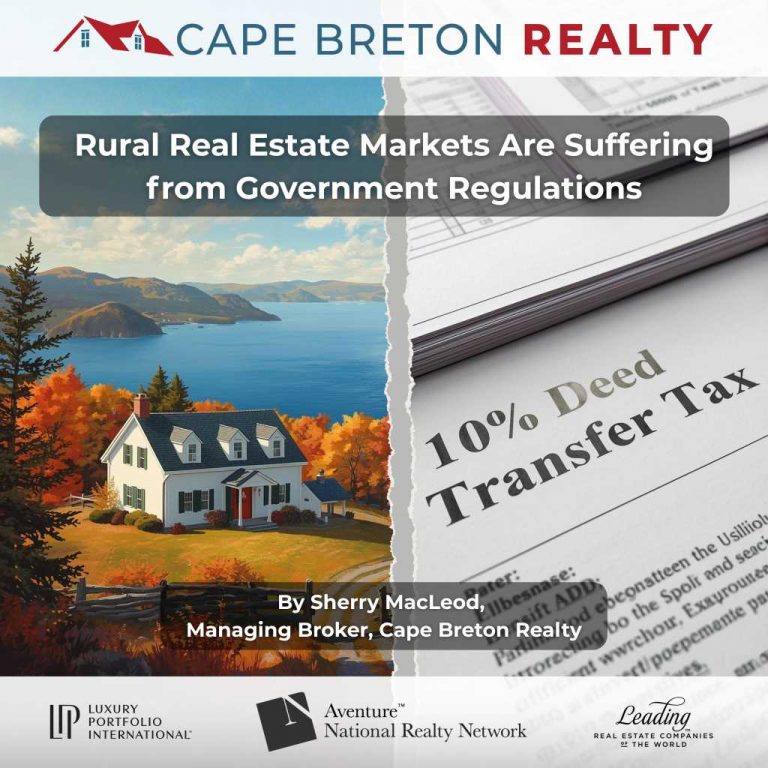
By Sherry MacLeod, Managing Broker, Cape Breton Realty
As 2025 comes to an end, one message has become clear across rural Nova Scotia: government policies are hurting small communities that desperately need growth. And the most damaging of these policies is the 10% Provincial Deed Transfer Tax (PDT).
The PDT Tax: A Tariff Between Provinces
Premier Tim Houston has said Nova Scotia will lead the country in removing interprovincial trade barriers. Yet this year, the province doubled the Deed Transfer Tax from 5% to 10%, effectively creating a tariff on Canadians from other provinces unless they move here full-time.
At a time when Canada should be encouraging mobility between provinces, Nova Scotia has chosen to close its doors.
This tax makes our province significantly more expensive than our neighbours. New Brunswick has no provincial or county deed transfer tax, and both PEI and Newfoundland remain far more competitive. On a $500,000 property, the PDT adds an extra $50,000 just to get the keys. Even at 5%, the tax was burdensome—but at 10%, the impact has been devastating. Most counties also charge their own deed transfer tax on top of this.
Rural communities rely on out-of-province buyers to fill homes, support local businesses, and keep villages vibrant. Instead of attracting people, this tax drives them away. It must be rolled back to 5% at minimum—or removed entirely for rural areas—before more damage is done.
Foreign Buyer Ban: Designed for Cities, Punishing Rural Areas
While the PDT tax burdens Canadians, the federal foreign buyer ban shuts out the rest of the world. Intended to cool overheated markets like Toronto and Vancouver, rural Nova Scotia was swept up in it.
Entirely rural communities such as Gabarus, Marion Bridge, Louisbourg, Mira, and other outlying CBRM areas were included simply because they fall within a large municipal boundary—even though they have nothing in common with big-city markets.
The consequences are unmistakable:
•A fully restored oceanfront farmhouse in Gabarus sat on the market for more than a year.
•A stunning waterside property in Irish Vale remains unsold as the year comes to an end.
•Homes in St. George’s Channel, Dundee, Irish Vale, Big Harbour, and Roberta—once popular with European and American seasonal buyers—are lingering far longer than they did a decade ago.
Foreign buyers are no longer a major part of the market—nothing like they were 25–30 years ago—yet the sweeping ban created a chilling effect far beyond its intended targets.
When the ban was announced, international media ran dramatic headlines:
“Canada bans foreign buyers.”
The nuances and rural exemptions were lost. People overseas simply stopped looking at Canadian real estate. Even areas that were technically exempt felt the impact because the global perception became: Canada is closed.
Once international buyers shift their attention to other countries, it is incredibly difficult to draw them back.
Economic Ripple Effects Are Showing
With fewer buyers and fewer seasonal residents, rural economies are feeling the strain. Local shops and services are:
•opening later,
•closing earlier,
•cutting hours, and
•reducing staff.
High-end homes take longer to sell. New construction—once supported by foreign and out-of-province buyers—is way down. Tradespeople have fewer projects. This does not help the housing crisis; it worsens it. When investment slows, so does housing supply.
I now see seniors reducing their listing prices by 10% just to compensate for this tax. Buyers are limited, and this is the reality. Or, sellers simply don’t sell. Farmhouses deteriorate. The buyer pool continues to shrink.
It’s Time for Common-Sense Policy
Rural Nova Scotia is not facing the challenges of Toronto or Vancouver. The PDT tax should not be punishing buyers or sellers who want to live and invest here. The foreign buyer ban should not be suffocating rural markets that historically relied on outside investment. Now more than ever, we need every investment dollar we can get.
As we head into 2026, it’s time to reverse the policies that are hurting the people and communities that need support the most. Rural Nova Scotia deserves the chance to grow, attract new residents—seasonal or year-round—and rebuild its economy.
We need government to stop putting policies in place that damage rural communities and start helping them thrive again.